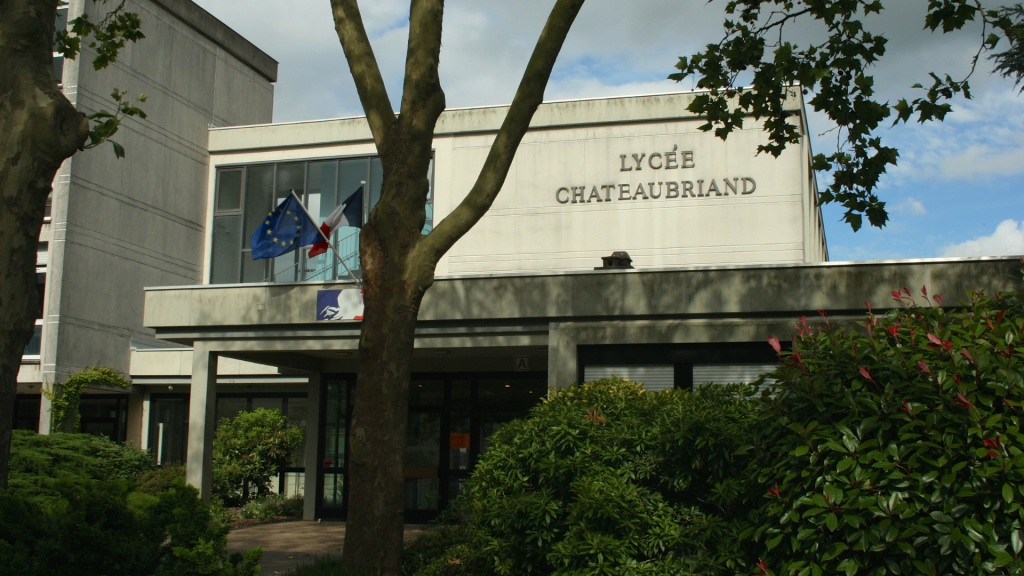
Lycée Chateaubriand, Rennes
After obtaining my high school diploma (BAC) with highest honors, I followed the advice of my physics and math teachers to enter the demanding world of Classes Préparatoires aux Grandes Écoles (CPGE).
Arriving with confidence, since I had passed the BAC fairly easily, I soon hit what students call the “prépa wall”. The pace, workload, and expectations were far beyond anything I had known before. It was the beginning of an intense two-year experience that left me with lasting memories — both challenging and rewarding.
Choosing the path
I had the choice between Chateaubriand in Rennes and Clémenceau in Nantes, both close to home. Initially, I wanted to pursue the PSI (Physics and Engineering Science) track, which was better ranked, and one of my best friends made the same choice. However, I ultimately joined the PC (Physics-Chemistry) track, which better aligned with my strengths and interests.
Preparatory classes are demanding but push students to always aim higher. At the same time, I realized that smaller, specialized schools are sometimes undervalued in favor of larger institutions that primarily train managers rather than experts (for example, Centrale).
Life in prépa
The rhythm was intense: a dense curriculum, daily work, and even exams on Saturday mornings. The focus was largely theoretical, but labs and TIPE projects provided a more applied dimension.
There are also “star classes,” which group the top students from first-year tracks. I narrowly missed being placed in one (by just two ranks out of 24), and in hindsight, I’m glad. Being in a slightly less competitive environment allowed me to perform better, express my knowledge with more confidence, and enjoy a more supportive atmosphere.
Projects (TIPE)
TIPE (Travaux d’Initiative Personnelle Encadrés) was one of the most enriching aspects of the CPGE program. I worked on:
- Superconductive train — a project exploring the principles of magnetic levitation using superconductors.
- Autocleaning glass — an investigation into how water droplets interact with surfaces, and how nanostructures can create self-cleaning materials.
These projects gave me my first taste of applied physics and materials science, bridging the gap between abstract theory and real-world applications.
Outcome
In the end, I entered Phelma – Grenoble INP through the CCINP competitive exam, with an average score of 14.14. Not outstanding, but enough to secure my first-choice school.
I found Phelma particularly appealing for its focus on materials science and nuclear engineering, even if my teachers advised me to aim “higher.” Once there, I realized how diverse the student body was: many came from different CPGE tracks, some had repeated years (“5/2”), and others came from star classes. This diversity made me question the hierarchy often presented in the French system.
I also heard from Centrale students that their programs leaned more toward management than technical depth, reinforcing my view that preparatory classes are often designed more as a competition for prestige than as a training ground for engineering expertise.
Reflection
While preparatory classes were tough, they gave me resilience, strong fundamentals in physics and math, and the ability to work under pressure. More importantly, they helped me define what I value in my studies: not just prestige, but real technical knowledge and meaningful projects.